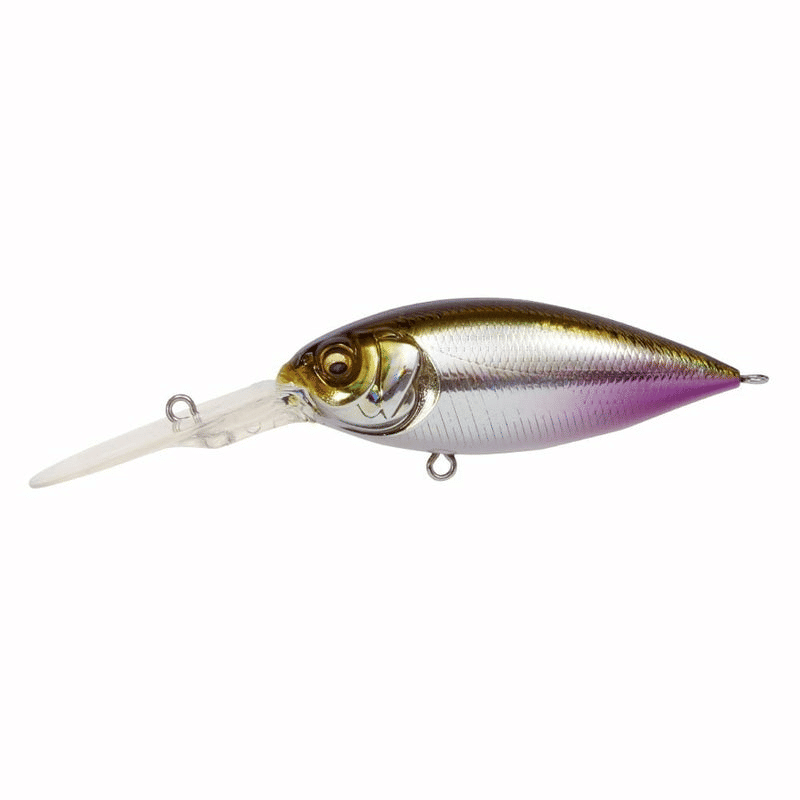
MEGABASS DEEP-X: THE ULTIMATE TOURNAMENT MENACE

The Engineering Behind the DEEP-X Lure
Deep cranking punishes inefficiency. Every foot of retrieve a bait spends climbing toward its running depth is a foot it isn't in front of fish, and over an eight-hour tournament day that wasted water adds up to hundreds of unproductive casts. The Megabass DEEP-X series was built to eliminate that waste, which is why it has held a permanent slot in the box of anglers who fish offshore structure for a living.
Most crankbaits need a runway. They wobble, stabilize, then gradually descend toward their advertised depth somewhere in the middle third of the cast. The DEEP-X platform attacks this problem at the design level rather than the retrieve level.
Mastering the Multi-Way Balancer System
The Multi-Way Balancer System (PAT.) is the component responsible for the DEEP-X's defining trait: a dive angle that approaches vertical rather than the shallow diagonal most crankbaits trace.

By controlling how internal mass settles and redistributes the instant the bait hits the water, the balancer forces the lip to bite down rather than plane forward. The bait drops into its working column almost under the rod tip instead of a third of the way back to the boat.
Conventional fixed-weight crankbaits can't do this. Their mass sits in one place, so the lip has to overcome forward momentum before it can convert horizontal travel into descent. That conversion requires distance — the runway. On a 60-foot cast to a deep ledge, a bait with a long runway may only be in the strike zone for the final 25 feet of travel.
The tactical advantages are significant:
-
Shorter casts become viable. Precision presentations to isolated brush, a single stump, or the tip of a point stay productive because the bait is working from the first crank.
-
Maximum time in the target zone. More of every retrieve is spent at depth, raising the number of fish that actually see the bait.
-
Boat-position flexibility. Vertical attainment means you can sit closer to structure without overshooting it.
-
Action under suspension. The balancer keeps internal mass responsive, so rod twitches translate into sharp directional kicks even when the bait pauses mid-column — a trigger mechanism most deep cranks simply don't have.

DEEP-X LBO: Casting Power and Feedback
LBO stands for Linear Bearing Oscillator, and it replaces the loose ball bearings found in most weight-transfer crankbaits with a single weighted cylinder that slides along a fixed internal track. On the cast, that cylinder travels rearward and locks the bait into a tail-heavy, low-drag attitude. On entry and retrieve, it returns forward along the same path every time, restoring the balance point the lip needs to run true.
The mechanical argument for a cylinder over loose spheres comes down to repeatability. Individual bearings rattle against each other, stack unpredictably, and can hang at partial transfer — producing a cast that falls short or a bait that starts the retrieve out of tune. A guided cylinder has one degree of freedom and one destination.

Deep-X 100 LBO: The Compact Powerhouse
The 100 is the small-bodied entry in the lineup, and its specifications clarify its role in a tournament rotation.
Specifications
Length: 2.33 inches (59mm)
Total length: 2 1/3 inches
Weight: 3/8 oz
Maximum depth: 8 feet
Weight system: LBO II linear bearing oscillator
Eight feet is a deceptively important number. It covers the shallow ledges, the tops of offshore humps, riprap transitions, and the 6-to-8-foot shelf that holds fish through the post-spawn period.
These are zones where a 15-foot bait is useless and a square bill runs too high. The instant dive matters most here, because at this depth you're often casting parallel to a bank or along a short break — presentations where a bait with a long runway never reaches the fish at all.
The compact 2.33-inch profile is the other half of the equation. On highly pressured water, where every boat in the field is throwing a full-size deep crank, a smaller silhouette that still reaches the target depth gives you a presentation the fish haven't rejected a dozen times already. It matches shad and small bluegill forage closely, and the 3/8-ounce weight keeps it castable on a standard medium-heavy cranking setup rather than demanding a dedicated heavy rod.

Deep-X 300: Dominating the 15-Foot Range
Picture a summer ledge in 18 feet of water with a shell bed running along its lip. The cast lands long, past the break. One turn of the handle and the 300 is already angling down, not planing. By the time the line crosses the drop, the bait is in the 15-to-17-foot window and tracking hard against the bottom composition — grinding, deflecting, and staying there.
That window — the stretch between 15 and 17 feet where summer and late-fall bass stack on hard structure — is where the DEEP-X 300 earns its reputation.
The advantage is not just that the 300 gets deep. It's that it gets deep early and stays deep long. A bait that spends the first half of its retrieve descending and the last quarter climbing out gives you a short productive middle.
The near-vertical attainment delivered by the Multi-Way Balancer collapses that descent phase, converting it into working time. Across a full day of offshore cranking, more time in the target zone is simply more opportunities, and deep-water bass rarely chase far — the bait has to arrive in their lane, not above it.
The balancer system also pays off on contact. When the lip buries into a stump or wedges against rock, the internal mass redistributes and helps the bait roll out of the obstruction rather than pinning against it. That self-correcting behavior is what lets you crank aggressively through the exact cover that holds fish, instead of easing the bait along the edges of it.
Durability and the Art of JDM Finishes
Deep cranking is contact fishing. A bait that runs 15 feet down is spending its working life collided with rock, shell, timber and gravel, and the structural demands on the body, lip joint and hardware are unlike anything a topwater or jerkbait faces. The DEEP-X construction is built around that reality — a rigid body shell that resists the torsional load of a deflection, with the lip seated to take repeated impact without developing the play that throws a crankbait permanently out of tune.
That rigidity is also what protects the tuning you paid for. A bait that flexes at the lip joint after fifty rock deflections will start running sideways, and no amount of eye-bending fully fixes it.
The finish work is where Japanese manufacturing separates itself:
-
Multi-layered coating depth. Megabass finishes are built in layers rather than sprayed flat, so the color sits beneath a clear shell that absorbs hook rash instead of chipping at the first treble strike.
-
Impact resistance at the belly and shoulders. These are the contact points on a bottom-grinding retrieve, and the coating holds color through the abrasion that strips lesser paint to white plastic.
-
Optical realism under clear water. Internal foils, scale detail and translucency are layered to react to ambient light the way baitfish scales do — which is precisely the condition where pressured, clear-water tournament fish are most likely to refuse a flat, opaque bait.