Mastering Topwater Lures for Bass Fishing: A 2026 Guide to Surface Strike Engineering


The Topwater Disconnect: Why Surface Strikes Often Fail
"The strike you see is the one you remember." Every angler who has watched a largemouth detonate on a floating plug understands why topwater fishing holds a different place than any other presentation.
Topwater fishing is a surface-level presentation designed to trigger a predatory reflex rather than a feeding decision. The bait sits in the film, breaks the surface tension, and forces the fish to commit upward against the sky. This method's allure lies in its visibility and the explosive action that often accompanies a successful strike.
The problem is rarely the bite. It's the connection. Most anglers lose fish because they're throwing the wrong profile for the water they're standing in — a loud chugger over glass-calm flats or a silent walker in three inches of chop. Selecting the right lure type, such as a popper for calm conditions or a walking bait for choppy waters, can significantly improve hookup rates.
There's also a spatial reality: a small fraction of any given surface area holds the bulk of the active fish. Edges, shade lines, points, and vegetation seams are prime locations that concentrate fish activity. Understanding these nuances can elevate an angler's success.
Japanese lure design approaches this challenge differently, treating weight distribution and acoustic signature as engineering problems with measurable solutions rather than afterthoughts. This meticulous attention to engineering details sets Japanese lures apart, ensuring optimal performance in various fishing scenarios.
Anatomy of Action: Categorizing Topwater Lures for Bass Fishing

Understanding the different types of topwater lures starts with how each one displaces water. The displacement and motion of the lure are key factors in triggering strikes from predatory fish.
Walking baits (spooks): A slack-line cadence produces the side-to-side "walk-the-dog" glide. Megabass staples like the Giant DOG-X and DOG-X Diamante anchor the category; the best topwater walking bait holds its rhythm without rolling over. These lures are ideal for mimicking distressed baitfish.
Poppers and chuggers: A cupped mouth creates the signature bloop that mimics struggling baitfish. The iconic Megabass POPX and POPMAX set the benchmark for topwater poppers for bass with their patented water-intake channels. The sound and splash they create are irresistible to fish.
Prop baits and buzzbaits: Topwater prop baits like the Megabass X-Plose or PropDarter throw a fine, subtle spray. A topwater buzzbait like the Megabass Jamaica Boa churns aggressively, covering water fast. These lures are excellent for covering large areas quickly.
Hollow-body frogs: Weedless topwater designs like the Megabass Big Gabot and Pony Gabot are made for matted vegetation, lily pads, and laydowns. Their unique design allows them to navigate heavy cover without snagging.
The Engineering Gap: Why Japanese Topwater Lures Outperform Standard Gear

The difference between a mass-market plug and a JDM bait shows up at distance and at the hookset. Japanese lures are crafted with precision and performance in mind, making them superior tools in an angler's arsenal.
Internal tungsten weight-transfer systems shift mass to the rear during the cast, then return it forward on splashdown. The result is longer casts into wind and an immediate, correct posture in the water — no dead seconds while the bait settles. This engineering innovation enhances casting distance and accuracy, crucial for reaching distant targets.
Acoustics are deliberate. High-frequency rattle chambers project through chop and stained water, while silent construction matters on pressured lakes where fish have heard every rattle in the tackle shop. A Megabass topwater lure is typically built around one of these two decisions, not both. This strategic design choice caters to different fishing environments.
Hook technology is where most missed strikes are decided. Ultra-sharp, thin-gauge Japanese trebles penetrate on glancing contact, converting slaps into hookups where thicker wire simply deflects. These hooks increase the likelihood of securing a catch, a critical factor for success.
Finish work — hand-painted scale detail, realistic 3D eye placement — serves the same purpose in clear water that acoustics serve in dirty water. These realistic finishes enhance the lure's appeal, making it more enticing to fish.
Technical Deep Dive: Maximizing Lure Action Through Retrieve
Dead sticking is the most underused trigger in topwater fishing. After the splashdown, let the bait sit until the rings disappear. Followers commit to stillness more often than to motion. This technique exploits fish's curiosity and patience.
Cadence variation matters more than speed. Three rhythmic pops, a long pause, then two erratic twitches reads as injured prey. A metronomic retrieve reads as a lure. Varying the cadence can trigger instinctive strikes from nearby fish.
Rod position controls the bait. A high tip lifts the nose and reduces splash; a low tip, pointed toward the water, drives a popper deeper into its chug and keeps a walking bait tracking tight. Mastering rod control can dramatically affect lure action.
Line choice is a trade-off. Floating monofilament keeps the nose up and adds forgiving stretch on the strike. Braid gives zero-stretch hooksets and ripping power through vegetation, but it sinks and can kill the action of a small topwater lure. Choosing the right line is essential for maintaining the intended lure action.
Topwater Lures for Bass Fishing: Environmental Selection Matrix
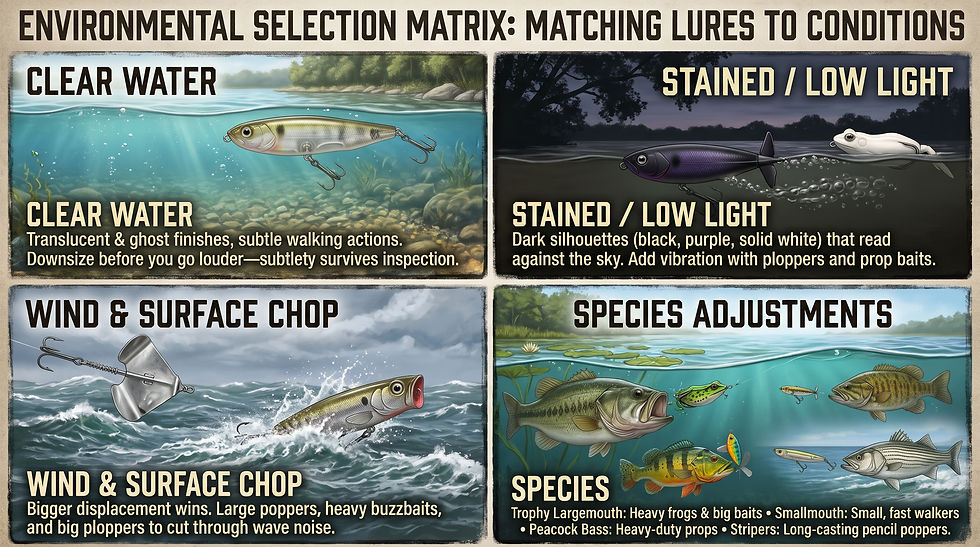
Clear water. Translucent and ghost finishes with subtle walking actions. Fish see everything, so the profile has to survive inspection. Downsize before you go louder. In clear water, subtlety is often more effective.
Stained or low light. Dark silhouettes — black topwater frog patterns, purple, or solid white topwater lures — read against the sky. Add vibration: a topwater plopper, a prop bait, or a Whopper Plopper for bass creates a sound trail fish can follow without seeing. These conditions call for bolder presentations.
Wind and surface chop. Bigger displacement wins. Large poppers, the best bass buzzbait in your box, or a whopper plopper 190 for bass cuts through wave noise that would swallow a finesse presentation. Rough conditions require robust lures.
Species adjustments. Trophy largemouth respond to big topwater baits and heavy frogs. Topwater lures for smallmouth bass skew smaller and faster — a Tiny Torpedo or compact walker. Topwater lures for peacock bass demand oversized woodchopper-style props that survive violent strikes, while striper topwater lures and pencil poppers for striped bass rely on long casts and a fast, erratic sweep. Tailoring lure choice to the target species is crucial.
Common Failure Modes in Topwater Presentations
Setting the hook on sight. The visual strike trap costs more fish than any other error. Wait until the rod loads and you feel weight, then sweep. Timing the hookset is vital for success.
Heavy or sloppy knots. A bulky connection dampens the pivot point on a precision-built bait. Use a loop knot where the manufacturer's action depends on free movement at the line tie. Proper knot tying preserves the intended lure action.
Ignoring the follower. When a bass trails without committing, change something immediately — kill the bait, speed it up, or make the next cast with a different profile entirely. Repeating the same retrieve rarely converts. Adaptability can make the difference between a missed opportunity and a successful catch.
Over-working the bait. Moving the lure too fast pulls it through the strike zone before the fish can close the distance. Slow down through cover, shade, and ambush points. Patience and precision in lure retrieval often yield better results.
Limitations and Considerations for Surface Fishing
Topwater is a conditional tool, not a universal one. Its effectiveness is influenced by various environmental factors.
Water temperature sets the first boundary. As surface temperatures drop toward the mid-50s, bass metabolism slows and the willingness to chase upward falls off sharply. Cold-water topwater bites still happen, but they become exceptions rather than patterns. Understanding seasonal variations is key to successful topwater fishing.
Depth sets the second. When fish relocate to offshore structure, ledges, and deep brush, a surface lure requires them to travel too far for too little reward. Vertical presentations and deep-running baits simply put the offering where the fish live. Choosing the right depth presentation ensures you're fishing where the fish are.
Hook-up ratios are the honest trade. Surface strikes miss more often than a jig or a Texas-rigged worm, where the fish takes the bait into its mouth before you ever feel it. You accept lower conversion in exchange for the visual explosion and the ability to cover water fast. Accepting these trade-offs is part of the topwater fishing experience.
When fish rise but refuse to break the surface, drop to a wake bait or a subsurface glider running just under the film. These alternatives can often coax cautious fish into striking.
Frequently Asked Questions About Topwater Bass Fishing
What's the best topwater popper for 2026? Look for a deep cupped mouth and a tail-weighted body that holds a nose-up rest position. Versatility beats specialization here. The right popper can adapt to various fishing conditions.
What attracts trout compared to bass? Trout generally respond to smaller, insect-mimicking profiles, while bass key on baitfish and amphibian silhouettes. Understanding the preferences of different fish species is crucial for selecting the right lure.
What does topwater fishing mean for beginners? You're fishing the vertical strike zone — the column of water a fish will travel upward to attack. Everything happens where you can see it. The visual aspect of topwater fishing makes it accessible and exciting for beginners.
How do I fish a topwater frog in heavy weeds? Pop-and-stop. Two short twitches to move the frog across the mat, then a pause in every open pocket. This technique is effective in enticing strikes in weedy areas.
The Bottom Line: Summary of Surface Success
Match the lure's acoustic footprint to water clarity and surface tension — loud and large in chop, silent and subtle on glass. Adapting to environmental conditions enhances lure effectiveness.
Invest in Japanese engineering where it pays: weight-transfer casting systems and thin-gauge hooks convert more of the strikes you already get. High-quality equipment can significantly improve your fishing success.
Patience governs the hookset. Let the fish take the bait down and load the rod before you swing. Timing is crucial for successful hooksets.
Treat topwater as a seasonal weapon. It peaks from post-spawn through early fall, then narrows as water temperatures fall. Recognizing seasonal patterns is key to maximizing topwater fishing success.
The explosion is the point. The equipment just determines whether it ends with a fish in the net. The thrill of topwater strikes is unmatched, and proper gear ensures those thrilling moments result in successful catches.
Where to Look Next
Build your selection process on documentation rather than guesswork. Informed decisions lead to better outcomes.
Start with manufacturer specifications — buoyancy ratings, weight, and recommended retrieve speeds are published for most premium Japanese baits and tell you more than a product photo will. This information helps in choosing the right lure for specific conditions.
Check regional fishing guidelines and state agency reports for seasonal bass activity patterns and local regulations on hook configurations. Being aware of local regulations ensures compliance and enhances fishing success.
Review industry standards for hook sizing and line strength so your terminal tackle matches the bait's design intent rather than fighting it. Properly matched tackle optimizes lure performance.
For deeper context, academic texts on black bass predatory behavior and sensory systems explain why acoustics and silhouette work the way they do. Understanding the science behind lure effectiveness can enhance your fishing strategy.